Seiran Tsuno’s Costume Art. ITS Contest 2018 finalist in the latest MET Exhibition.
14 Maggio 2026
Japanese born Seiran Tsuno was nothing short of a creative shock when she landed her application for ITS Contest in 2018. First of all, nobody would have expected a part-time fashion designer to come up with such a revolutionary idea while working as a psychiatric nurse. Second of all the technique: garments entirely produced out of melted polylactic acid filaments with a 3D doodle pen, resembling spirits from the unseen world. Worn as necklaces, they appeared as “Wandering Spirits” (the title of the collection) floating mid-air, barely hanging from the neck of the wearer. Outfits that could “communicate with the unseen world” which is often a reality for those who suffer from a mental illness. Structures of metaphorical and actual fragility: Upon arrival in the summer of 2018 for the finals of ITS Contest Seiran literally spent hours unpacking her collection and re-constructing broken sections and deliberate separations she had made in order to be able to ship it.


Seiran Tsuno and The Met’s Costume Art exhibition
Fast forward to the end of 2025, and Seiran is contacted by legendary head curator of the Anna Wintour Costume Center at the Metropolitan Museum, Andrew Bolton. There is interest in featuring a custom version of one of her pieces in the upcoming exhibition Costume Art. “Having my work exhibited at The MET has been one of my big dreams” told us Seiran, “so I feel truly happy and honored to have been given this opportunity. It still does not quite feel real to me.”
What makes it even more meaningful for Seiran is that the exhibition focuses on bodies that have often been overlooked in fashion, using custom mannequins made by scanning the bodies of real people. With a body of work that, in the words of Andrew Bolton, see Seiran creating “ethereal garments that interrogate bodies often marginalized in fashion, reflecting her practice – which bridges fashion, her work as a psychiatric nurse, and fat studies” it couldn’t feel more the right time for this dream of hers to come true.
Another interesting aspect of the exhibition is that each garment is displayed in dialogue with a work of art. Her piece is shown alongside Edvard Munch’s The Scream, an idea of Andrew Bolton which Seiran found fascinating. “Munch’s decisive, heavy black lines, evoking a suffocating existential anguish” wrote Bolton, “stand in stark contrast to Tsuno’s fine white filaments, which suggest fragile, porous, and ultimately redemptive sublimity in their transparency.”
Following the MET Gala a few days prior, Costume Art has opened on May 10th and will be on until January 10th, 2027 and it once again displays Andrew Bolton one-of-a-kind talent to transform fashion exhibitions into immersive cultural narratives rather than traditional museum displays. We had the opportunity to interview Seiran about it, to dive deep into this once in a lifetime experience.
Interview with Seiran Tsuno
1. How and when were you approached by MET for the exhibition?
In mid-October last year, I received a very thoughtful email from Andrew Bolton. It was about the possibility of creating a work for the following year’s special exhibition at The Costume Institute. Andrew was planning to come to Tokyo the following week and kindly suggested that we meet in person to talk. However, at that time, I was away from Tokyo for the installation of my solo exhibition at the 21st Century Museum of Contemporary Art, Kanazawa. So I asked my husband and manager, Tsuyoshi, to meet Andrew on my behalf. With Tsuyoshi’s support, I joined them on Zoom and was able to speak with Andrew directly. During that conversation, I explained my past work and the concept behind my pieces, and answered Andrew’s questions. Although we met through a screen, I felt that he was very kind, gracious, and deeply full of love for clothing and for the people who make it.
2. Were they looking for a specific piece you had already produced, or did they give a brief for the production of a custom piece?
What The Met was interested in was my series of garments made with a 3D pen, which appear to detach from the body. They were part of a collection I created for ITS Contest.
For this custom piece, I recreated the work based on the same technique and concept as that series, while the color and form were developed in response to a request from Andrew and the curatorial team at The Met. To develop the piece, I made several drawings with different patterns, and they selected one from among them.


Sketch and development process.
Photo credit for Seiran piece on black background: Fumiya Sakurai
3. Can you tell us about the concept and the development of the piece? During the production process were there any problems you had to figure out and solve, and how did you do that?
This series was originally titled Wandering Spirits when I presented it at ITS Contest, but last year I changed the title to Out of Body, In Dress so that the concept could be communicated more clearly.
Once the design was finalized, the period between production and shipping was initially very short. For that reason, I asked Keisuke (Seiran’s assistant – Ed.) who had supported me since the time I made the original pieces for ITS Contest, to help me, and we worked intensively over the New Year’s holidays to complete the piece.
At the same time, I was also in the middle of submitting my master’s thesis, so it was an extremely demanding period. I had explained the situation to my graduate school professor, which allowed me to keep working until the very last moment. Somehow, I managed to complete both the production of the work and my thesis in parallel. In March, I also successfully completed my master’s program.
Through making clothing, I have been exploring how we relate to our own bodies. For me, the body does not always feel natural, or entirely “mine.” I do not think this is limited to illness or disability. In a society where idealized images of the body are so strongly constructed, many people may feel some kind of distance from their own bodies.
This interest comes from my own experience of having a fat body since childhood, and from my work as a psychiatric nurse, where I have met people living with mental and physical phenomena that cannot be easily controlled.
I see clothing as a kind of clue for exploring the history of how people have related to their own bodies. Clothing has, in each moment, given a place to bodies that cannot be fully controlled and that continue to change from day to day.
For that reason, making clothing is also a way of touching the history of how a person feels their body, how they wish to exist, and how they have related to their bodily sensations and to their body itself. Out of Body, In Dress was the starting point of this exploration for me.
4. Were you involved in the setup of your piece in the exhibition? Did you travel to New York for that, and if so, how was it? What was the experience like and who did you work with from the MET team?
Yes, I was able to visit The Met in person.
For the installation of the work, I prepared and sent an instruction manual in advance. I also requested that, if a mannequin were to be used, it should not be a standardized conventional mannequin, but one with a more realistic sense of bodily presence. Based on these instructions, Glenn Petersen and the conservation team installed the piece truly perfectly.
Because the work is extremely delicate, I brought repair tools with me to The Met in case any damage had occurred. However, when I arrived, the piece had already been installed in a very beautiful condition, and no repair was necessary.
During my visit, Ayaka Iida, a Japanese researcher at The Costume Institute, guided me through the exhibition space and also showed me the catalogue. My dress is the only one not worn by a mannequin, and this was in response to my request, which was important to the concept of the work. I am very grateful for that as well.


Seiran with Andrew Bolton and showing the technique to Glenn Petersen, Head of Conservation at The Met.
I also spoke with Glenn Petersen, Chief Conservator at The Costume Institute, who leads the conservation team, and explained how to repair the piece with a 3D pen in case any damage should ever occur in the future. I also took part in an interview.
Finally, I was able to meet Andrew Bolton in person. He gave me a hug, and he was truly warm. I felt his love for clothing and his deep respect for makers. It was a great honor for me, and the entire experience felt like a dream.
5. If you look back to yourself in 2018, landing in Trieste for ITS Contest, revealing that creativity to the world for the first time, seeing then exhibited in the first exhibition of ITS Arcademy…and today’s Seiran, evolving that DNA and presenting it in an exhibition at the MET in New York. How do you feel you’ve changed? Who is Seiran now and what are your plans for the future?
It feels deeply meaningful to me. I do not think I would have made this dress without ITS Contest.
Until then, I had mainly been making headpieces, so the 3D-pen dress I presented at ITS Contest was my first full-scale attempt at making clothing. After the competition, I did not continue making garments in the conventional sense as a fashion designer. Rather, while continuing my work as a psychiatric nurse, I began to explore, across different fields, the body, care, and the relationship between the self and the body that I encountered through that work.
Today, I create work as an artist, and I also write for literary magazines. This spring, I also received my master’s degree in Arts and Sciences from Institute of Science Tokyo, also known as Science Tokyo.
My research is art-based research grounded in Merleau-Ponty’s phenomenology of the body. Through the collaborative making of clothing with people who feel some difficulty in accepting their own bodies, I explore together with them their bodily sensations and their ways of relating to their bodies. I am interested not only in the representation of clothing itself, but also in the changes in the relationship that emerge during the making process between the maker and the body that becomes the subject of the work.
This interest also grew out of my continued reflection after making the 3D-pen dress for ITS Contest — asking myself, “What exactly was that?”
I would like to continue making work with this exploration at the center: the body, clothing, care, and the relationship we have with our own bodies.
ITS Contest designers in Costume Art
In addition to being featured in the exhibition, Seiran Tsuno’s piece has been permanently acquired by The Costume Institute, as happened in the past with Felix Chabluk Smith, ITS Contest 2013 winner. Back then the chief curator at The Costume Institute was Harold Koda, who attended the fashion jury that year and fell in love with Felix’s historical journey through the eras of menswear, acquiring his entire project for the permanent collection of the museum.

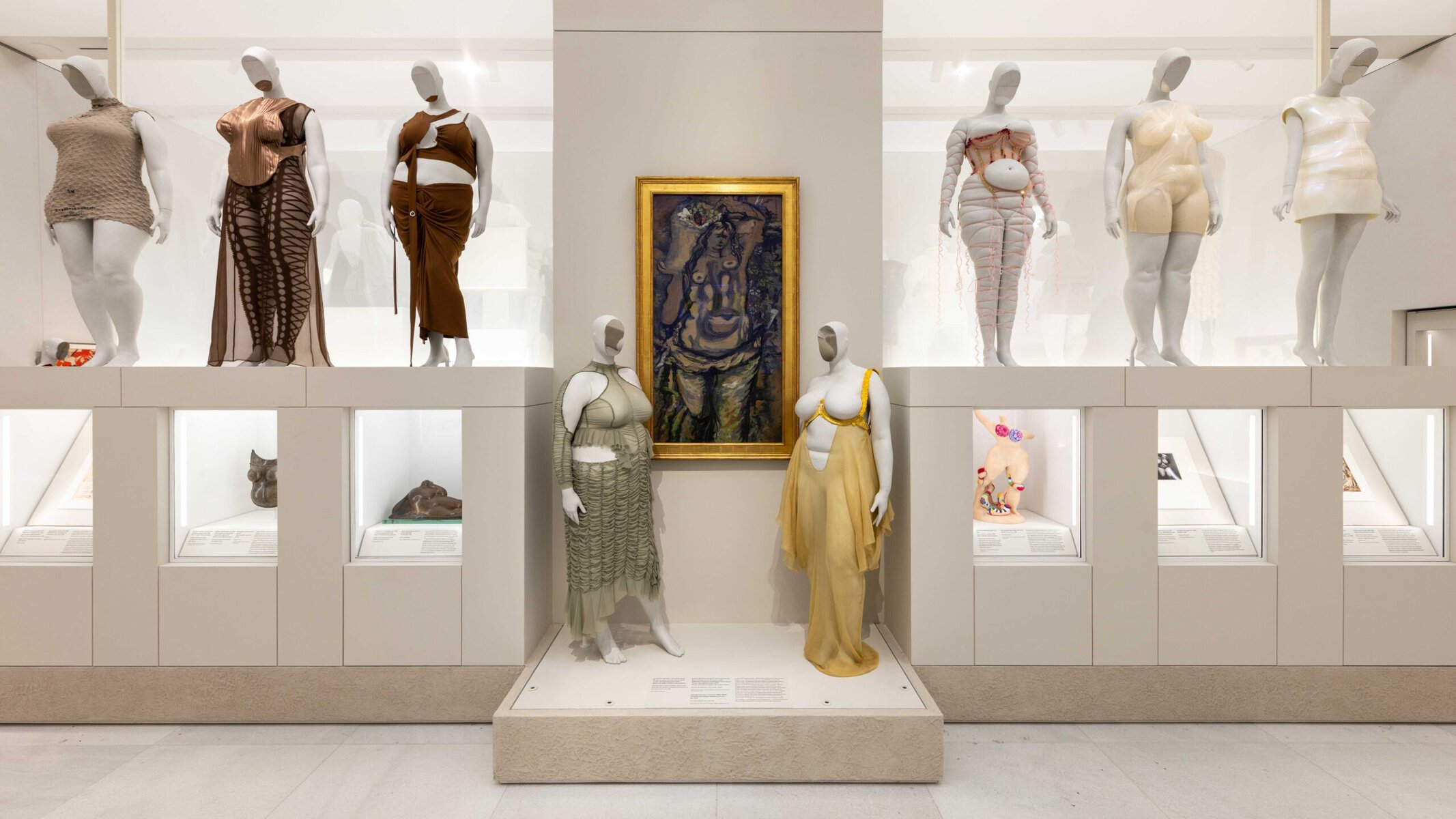
Images from “Costume Art” at the Metropolitan Museum, courtesy of The Costume Institute. Photo credit: Nicholas Calcott.
Seiran Tsuno is not the only designer discovered through ITS Contest to appear in the exhibition. Among the figures whose trajectories intersect with the project is Demna — a participant in ITS Contest 2004 and today Creative Director of Gucci — represented by a 2019 garment included in the “Inscribed Body” section and created for Vetements, the label he founded in 2014 and through which his radical redefinition of contemporary fashion first emerged.

“Inscribed Body” section, including garment by Demna for Vetements.
A similar path of evolution is reflected in Matthieu Blazy, winner of ITS Contest 2006. After formative experiences at Raf Simons and Maison Margiela, Blazy went on to lead Bottega Veneta and now serves as Creative Director of Chanel. In the exhibition, he is represented by a dress developed for the historic French maison (“Naked and Nude Body” section) he currently guides, offering a glimpse into a career shaped by continuity between experimentation and heritage.

“Naked and Nude Body” section, including garment by Matthieu Blazy for Chanel.
The exhibition also brings together designers who today operate under their own names. Richard Quinn, ITS Contest 2018 participant, has gained international recognition for his revival of traditional haute couture language combined with bold floral prints, while Yuima Nakazato — selected for ITS Contest in consecutive editions in 2008 and 2009 and the only Japanese designer invited to present within the Paris Haute Couture calendar — represents another significant chapter of the archive preserved by ITS Arcademy – Museum of Art in Fashion.
Costume Art further expands this dialogue through three creations by Michaela Stark, whose practice aligns closely with the exhibition’s curatorial focus. Stark’s work operates as a cultural critique of the body itself; notably, her own body was among those scanned by the team led by Andrew Bolton for the production of the custom mannequins that wear her garments throughout the show.
Questions of feminism and the deconstruction of conventional body imagery also inform the work of Clémentine Baldo, designer of ITS Contest 2024, who actively collaborated with Michaela Stark’s team in the development of the three pieces presented.

“Corpulent Body” section, including garments by Michaela Stark.
Fashion as a critical cultural language
Ultimately, the conversation between body and garment — and the recognition of fashion as an artistic practice — lies at the heart of Costume Art and mirrors the broader research pursued by ITS Arcademy itself. Our identity as a Museum of Art in Fashion reflects an ongoing curatorial investigation into how clothing shapes, frames and transforms the body. The current exhibition EXPOSURE – The Power of Being Seen, from Harry Styles to Lady Gaga continues this exploration, positioning the museum within an international discourse shared by major institutions such as The Metropolitan Museum of Art, where fashion is increasingly understood as a critical cultural language rather than a purely decorative form.